Conflicting labels of “freedom fighters” and “terrorists”
Noughts & CrossesThe language of “freedom fighters” and “terrorists” is a contested political vocabulary in Noughts and Crosses, not a neutral choice between two interchangeable names. The Liberation Militia’s members describe themselves as fighters for equality, while officials and news reports identify them as terrorists because of bombing, killings, and threatened attacks. The disagreement reflects the story’s racial hierarchy and the Militia’s challenge to it, but it also sharpens a difficult distinction: a movement’s account of oppression does not make its violence against innocent people disappear, just as official denunciation does not make the oppression it cites disappear.
Competing Names and Political Claims
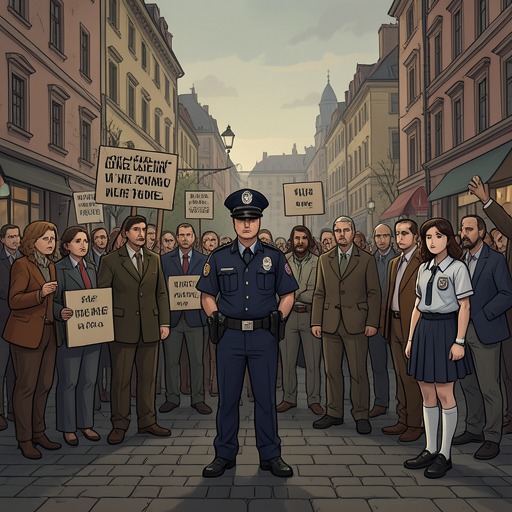
When Minerva asks why anyone joins a terrorist group, Callum rejects the label and calls the Militia freedom fighters. Minerva answers that the group bombs and kills innocent people; Callum counters that Cross oppression also kills Noughts, mentally and physically, through abuse. He says Noughts have tried to make their experience heard without being listened to, and that the Militia’s actions are intended to force Cross society to pay attention. Minerva challenges the means as well as the name: bombing and killing, she argues, loses the group sympathy rather than winning support.
Callum refuses the appeal to sympathy. He says the Militia wants equality and the same rights and freedoms Crosses enjoy, not pity. The exchange makes the competing terms do more than describe allegiance: “terrorist” centers the harm caused by the group’s actions, while “freedom fighter” centers the political objective and the grievances it claims to answer. Neither character resolves the disagreement by establishing that one description cancels the other. Instead, the conversation shows how the same acts are interpreted through conflicting accounts of power, responsibility, and whose suffering is recognized.
Violence, Reprisal, and Personal Grievance
The Militia’s political vocabulary sits beside concrete acts and intentions. Callum recalls that he first learned of the organization through his father’s warning that once it had someone, it never let them go. Over the following years he entered its ranks, moving from tea boy to grunt, then private and sergeant. The organization offered him a place in a cell and a hierarchy of responsibility, but his account also shows how membership became bound up with personal revenge: he used the Militia’s contacts and resources to target three Heathcroft pupils who had assaulted Sephy because she sat with him. He describes researching their vulnerabilities and retaliating against them, while acknowledging that he lost more of himself in the process.
The distinction between public cause and private grievance becomes harder to hold when Callum blames Sephy for his brother’s death. During his argument with Minerva, he says that if not for Sephy, his brother would still be alive. His accusation turns the abstract debate over political justice into a personal claim of responsibility, one that helps explain the force of his anger without settling whether his conclusion is fair. Across these episodes, the language of liberation can frame retaliation as part of a struggle for equality, even when its immediate targets are individuals and the consequences deepen the cycle of violence.
State and Media Framing
A newspaper report about a Nought man shot by police at Ackton Palace train station demonstrates how sharply the labels divide public accounts. The report says he wore a money belt packed with explosives and quotes a police spokesperson claiming that he intended to detonate a bomb on a commuter train during rush hour. The spokesperson presents the shooting as necessary to prevent mass casualties, calling the man a terrorist and describing the Militia’s acts as cowardly. A Nought eyewitness, by contrast, says plain-clothed officers opened fire as soon as the man entered the concourse and that he had no chance to surrender. The report places those accounts beside one another, but their incompatible descriptions leave the reader with contested responsibility rather than a single uncontested explanation.
The Militia’s press release calls the shooting state-sanctioned murder and says its member was not given a chance to surrender. It links the alleged state action to the continuing conflict between Noughts and Crosses. Kamal Hadley, speaking as Deputy Prime Minister, calls the group’s members subhuman terrorists and says their disregard for life will bring about their defeat. The sharply different vocabulary is itself part of the political struggle: the Militia treats state violence as evidence of oppression, while the government describes the organization as a threat that must be defeated.
Consequences and Narrative Significance
The public language surrounding the Militia is further complicated by the story’s record of violence, captivity, and punishment. Its members plan an operation at the Dundale shopping centre, and Callum realizes Sephy is there; later, the organization holds her for ransom and makes her father’s access to her conditional on the release of five imprisoned members. These acts make the label “terrorist” more than a rhetorical invention, even as the Militia’s stated demand for equal rights remains part of the account. The novel keeps both the cause and the means in view rather than allowing either to stand in for the whole conflict.
The closing news report returns to the competing names after Callum’s execution. It identifies him as one of the Nought terrorists who kidnapped Sephy and says that she became pregnant while held captive. That summary gives the official label the authority of published fact, but its compressed account also turns a complex relationship and a political crisis into a few lines of news. Read alongside Callum’s argument with Minerva and the Militia’s own statements, the repeated labels reveal how public narratives distribute sympathy and blame. The struggle is not only over who is called a fighter or a terrorist; it is also over which histories of harm become visible, whose claims are treated as credible, and what kinds of violence the state or its opponents present as justified.